


Quick answer: A fitted sheet comes off because the pocket is too shallow for the mattress, not because the sheet is faulty. Measure the mattress thickness with the topper on and match it to the pocket depth. If the sheet is the right size and still slips, the elastic has stretched, and clips or straps will hold it until you replace it.
Everyone has done this at three in the morning. One corner has let go, there is bare mattress under your shoulder, and you are half asleep trying to stretch the sheet back over it. By the following night it has happened again.
Almost every guide on this subject jumps straight to clips, straps and velcro. Those fix the symptom. In most cases the sheet was simply the wrong size to begin with, and no accessory will make a sheet fit a mattress it was never cut for.
So this starts with why it happens, because once you know which cause you have, the right fix is obvious.
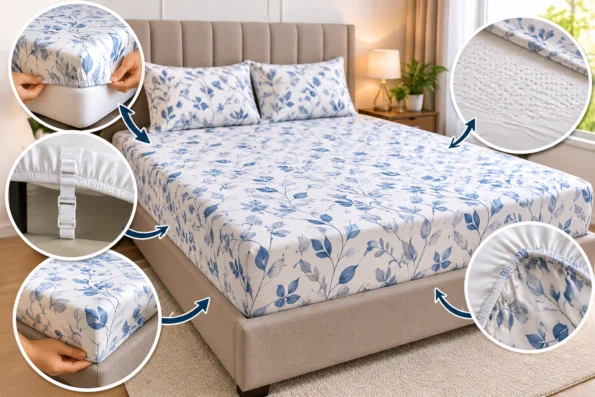
Why a fitted sheet slips off the mattress
Six things cause it, and five of them have nothing to do with the quality of the sheet. Working out which one you have takes about two minutes.
The commonest by far is pocket depth. The pocket is how far the sheet reaches down the side of the mattress before the elastic pulls it under. If the mattress is thicker than the pocket, the elastic ends up gripping the side of the mattress instead of the underside, and any movement lifts it off.
Shrinkage is the second, and it explains the sheets that used to fit and no longer do. Cotton shrinks in the wash, mostly the first time, and every inch lost from the pocket brings the elastic higher up the side of the mattress.
A mattress topper is the third, and the most overlooked. Adding a two inch topper to a nine inch mattress makes it an eleven inch mattress. The sheet has not changed but the job it has to do has.
Worn elastic is the fourth. Elastic loses its stretch with heat and age, and once it has gone slack it cannot grip anything, whatever size it is.
Slippery fabric is the fifth. Satin, silk and very fine high-count cotton have less friction against a mattress than plain cotton does, so they slide more readily even at the right size.
The sixth is the mattress surface itself. A smooth, tightly covered foam mattress gives the sheet far less to hold on to than a quilted or textured one.
Measuring the mattress properly, including depth
Measure the width, length and thickness in inches, with the topper and protector already on, then match the thickness to the stated pocket depth. This is the fix for most cases, and it is the only one that solves the problem rather than working around it.
Stand the tape on its end against the side of the mattress for the thickness. That is the measurement people skip, and it is the one that decides whether a fitted sheet works.
Pakistani mattress sizes give you the width and length. A standard double is 60 by 78 inches, the wider queen is 66 by 78, and a king is 72 by 78. But those are surface dimensions and they tell you nothing about depth, which is where the fit actually fails.
Depths vary widely here. A spring mattress might be six inches. An orthopaedic foam mattress commonly runs eight to ten. Two mattresses stacked on one bed, which is normal in older homes, can reach sixteen or more.
Once you have the three numbers, match them against the listed pocket depth rather than against a size name. A nine inch mattress with a ten inch pocket works. A nine inch mattress with a seven inch pocket will not, no matter how you stretch it.
Every listing in our fitted sheet range states its own measurements in inches. If you are unsure which size your bed needs, send the three numbers to 0324 492 4274 and we will tell you before you order.
Which pocket depth to order for a Pakistani mattress
Add one to two inches to your total stack and order the next pocket depth up from that figure. The trade uses three broad categories, and knowing where your bed sits removes the guesswork.
Standard pocket sheets run roughly seven to twelve inches and suit most spring mattresses and thinner foam. Deep pocket runs around fourteen to sixteen inches, which covers thicker orthopaedic foam and anything with a topper on it. Extra deep goes from about seventeen to twenty-two inches, for pillow-top mattresses, stacked mattresses, or a thick mattress with both a topper and a protector.
Work out your own figure by adding everything the sheet has to cover. Mattress thickness, plus topper, plus protector. Then add one or two inches of buffer on top, partly for movement and partly for the shrinkage that is coming.
So a nine inch foam mattress with a two inch topper and a protector comes to about eleven and a half inches. Add the buffer and you want a pocket of at least thirteen, which puts you in deep pocket territory rather than standard, even though the mattress by itself sounded ordinary.
Erring deeper is the safer mistake. A pocket slightly too deep leaves extra cloth you can push under the mattress, where it adds grip. A pocket slightly too shallow gives you the problem this whole article is about.
Shrinkage quietly changes the fit
A sheet that fitted when new can stop fitting after a few months, because cotton shrinks and the pocket gets shallower. This is the cause people never suspect, since nothing about the bed has changed.
There is hard testing behind this. Consumer Reports found cotton sheets shrinking by up to 6 percent, with some no longer fitting even a thin eight inch mattress after just fifteen washes. After twenty-five wash cycles, only a few of the sets tested still fitted a fourteen inch mattress. That is the entire problem in one finding: the sheet was correct on day one and the mattress had not changed.
On a flat sheet, shrinkage only eats into your tuck margin, which you can live with. On a fitted sheet it comes directly off the pocket depth, and a sheet that had one inch of margin has none.
Hot water and hot drying accelerate it. So does full sun, which is how most Pakistani households dry bedding. The cloth stiffens and contracts faster in direct afternoon sun than it does in the shade.
There are two practical answers. When buying, choose a pocket depth with two inches to spare rather than an exact match. And wash cold or warm, drying in the shade, which slows both the shrinkage and the elastic wear at the same time.
A mattress topper changes the maths
Add the topper’s thickness to the mattress before choosing a sheet, because the sheet has to cover both. A topper is the single most common reason a sheet that used to work suddenly stops.
Foam toppers add two to four inches. A quilted mattress protector adds around half an inch, which sounds trivial and is enough to matter when the pocket was already tight.
The same applies in reverse. If you remove a topper, a sheet sized for the deeper stack will be loose and will wrinkle under the body, which is uncomfortable in a different way.
A protector has one useful side effect worth knowing. Because it sits between the mattress and the sheet and has its own grip, it can give a slippery sheet something to hold against, which sometimes solves a mild slipping problem on its own.
What to do when the elastic has gone
If the sheet is the correct size and still will not hold, the elastic has stretched out, and that is the end of its useful life as a fitted sheet. You can tell by stretching a corner between your hands. Good elastic snaps back. Worn elastic stays long.
Elastic fails before the cloth does, which is normal rather than a defect. Heat is what kills it, so hot washes, hot drying and long afternoons in direct sun all shorten it.
This is worth diagnosing honestly before spending money on accessories. Clips and straps will hold a sheet with dead elastic, but you are then paying to keep a worn sheet on the bed rather than replacing a cheap item.
The one exception is a sheet where the cloth is still genuinely good, which brings us to the fix most guides written outside South Asia never mention.
Getting elastic replaced or sewn in locally
Any darzi can replace worn elastic in a fitted sheet, or sew elastic into a plain flat sheet to make one, usually for a fraction of the price of a new sheet. This is common practice in Pakistan and it is genuinely worth knowing.
For a worn fitted sheet, the tailor opens the existing casing at the corners, pulls the dead elastic out and threads new elastic through. The cloth is untouched. If the sheet itself is still in good condition this is the sensible repair.
For a flat sheet, the tailor gathers each corner, stitches it into a box shape, and runs elastic either around all four corners or right around the perimeter. All-round elastic grips better. Corner-only elastic is cheaper and enough for a mattress that is not too deep.
Two things to specify when you hand it over. Ask for wide elastic rather than narrow, because narrow elastic cuts into the hem and fails sooner. And tell the tailor your mattress thickness, so the box corners are made deep enough rather than guessed.
This works well on plain cotton. It works less well on heavy or stiff cloth, which does not gather cleanly at the corners. If you are having a plain cotton set converted, the result is close to a factory fitted sheet.
Two honest limits are worth knowing before you spend money on the conversion. A tailored corner is a stitched box rather than a shaped seam, so on a mattress deeper than about ten inches the corners pull and the sheet sits tighter than a factory one at the same depth. And hand-threaded elastic is usually narrower and lighter than the elastic sewn into a manufactured casing, so it relaxes sooner and you may be back at the same tailor within a year.
For a thin mattress and a sheet whose cloth you like, the conversion is the sensible choice. For a deep foam mattress, or where you need it to hold for years, buying the right pocket depth outright is cheaper over time than converting twice.
Clips, straps and suspenders, and when they earn their place
These hold a sheet that is slightly loose, and they will not rescue a sheet that is the wrong size. That distinction is what most articles on this subject leave out, because the accessories are what they are selling.
Sheet clips are small clamps that grip the sheet and the mattress together at each corner from underneath. They are cheap, they are sold in most general stores, and they work on a sheet with a mild fit problem.
Sheet suspenders are elastic straps that run diagonally under the mattress from corner to corner, holding all four in tension at once. They hold better than clips and they are more trouble to fit, so they suit a bed you do not strip often.
Safety pins do the same job as clips for almost nothing, pinning the sheet to itself under the mattress. They work, and they will eventually leave small holes in the hem.
Where all three fail is on a genuinely undersized sheet. If the pocket is two inches too shallow, clipping it down simply moves the strain somewhere else and the sheet tears at the corner instead of lifting off it.
Friction fixes that cost nothing
Anything that gives the sheet more grip against the mattress helps, and some of it you already own. These are worth trying before buying accessories, because they are free and they often do enough.
A non-slip rug gripper or a length of shelf liner placed under each corner of the sheet, where the pocket meets the mattress, adds grip exactly where it is needed. A piece the size of your hand at each corner is plenty.
A quilted protector or a thin topper under the sheet does the same thing across the whole surface, since quilted fabric grips far better than a smooth mattress cover does.
And if your sheet is a slippery satin or a very fine cotton, consider which bed it belongs on. Plain cotton grips better, so move the satin set to a bed nobody sleeps in restlessly and put cotton where it is needed.
Putting the sheet on so it holds
Fit the two diagonal corners first, then the remaining two, so the tension is even across the whole sheet. Most people work around the bed corner by corner, which pulls the sheet tight on one side and leaves slack on the other.
Start with the top left corner, then go straight to the bottom right. That stretches the sheet across its diagonal and centres it on the mattress. Then fit the other two, which will already be close to where they need to be.
Tuck the excess fabric under the mattress rather than leaving it bunched at the sides. On a sheet with a generous pocket there will be extra cloth, and pushed under the mattress it adds grip instead of sitting loose.
Lift the mattress corner rather than dragging the sheet over it. Dragging stretches the elastic every single time, which is part of why elastic fails at the corners first.
Heat, humidity and why summer makes it worse
Sweat and humidity reduce friction between the sheet and the mattress, which is why the same sheet that holds all winter starts slipping in June. Nobody writing about this in a cooler climate has any reason to mention it, and in Pakistan it accounts for half the year.
Damp cloth slides more easily than dry cloth. On a hot night in Lahore or Karachi, with the sheet holding moisture and the sleeper turning over more often, a marginal fit becomes a failing one.
Heat also works on the elastic directly. Elastic loses stretch faster in a hot cupboard and in a hot wash than it does in ordinary use, so a sheet bought in winter can be measurably looser by the end of its first summer.
Two things reduce it. A cotton sheet handles this better than a synthetic blend, because cotton absorbs moisture into the fibre instead of letting it sit on the surface. And drying in the shade rather than full afternoon sun keeps the elastic alive considerably longer.
Washing and drying without wrecking the elastic
Wash in cold or warm water, dry in the shade, and never iron over the elastic. Heat is the only thing that meaningfully shortens elastic life, and all three of these are about keeping heat away from it.
Hot water is the first offender. It relaxes the elastic permanently, a little with every wash, and the effect is cumulative rather than sudden.
Full sun is the second, and it is the harder habit to change since most households here dry bedding outside. Hanging in a shaded, airy spot dries the cloth almost as fast and leaves the elastic intact.
Ironing is the third. Pressing directly over the gathered corners flattens and weakens the elastic in one pass. Iron the flat surface of the sheet if you want to, and leave the corners alone.
One more thing worth doing. Do not leave a fitted sheet screwed up in a tight ball at the bottom of a cupboard for months. Stored under tension, elastic sets in that shape and does not fully recover.
When to stop fixing and replace the sheet
Replace it when the elastic no longer snaps back, when the corner seams have torn, or when the cloth has thinned at the centre. A fitted sheet is a cheap item and there is a point where repair stops making sense.
The elastic test settles most cases. Stretch a corner and let go. If it returns to shape, the elastic is fine and your problem is size or friction. If it hangs slack, the elastic is finished, and either have it replaced or replace the sheet.
Torn corner seams are the other clear signal. That is where all the strain concentrates, and once the stitching has pulled out, a repair there rarely holds for long.
If the cloth has gone thin at the centre where the body rests, the sheet has reached the end of its life regardless of the elastic, and no amount of fitting will change that.
Our fitted sheets state the size in inches on every listing so you can match the pocket to your mattress before ordering, and bedding starts at Rs 1,850 with cash on delivery across Pakistan. If what arrives does not fit the way the measurements said it would, the seven day replacement covers it.
For children’s beds, where sheets come loose most often because children move most, the kids range is worth choosing for wash resistance as well as fit. For guest houses and hostels, where beds are stripped daily and elastic takes the most punishment, our hotel bedding is built for that cycle.
Frequently asked questions
Why does my fitted sheet keep coming off the corners?
The pocket is too shallow for the mattress depth, or the sheet has shrunk. Adding a mattress topper without sizing up is the most common trigger.
How do I know if my fitted sheet is the wrong size?
Measure the mattress thickness in inches with the topper on and compare it to the stated pocket depth. If the mattress is deeper than the pocket, no accessory will fix it.
Do sheet clips and straps actually work?
Yes on a sheet that is only slightly loose. On a genuinely undersized sheet they move the strain to the corners and the hem tears instead.
What pocket depth do I need?
Add your mattress, topper and protector together, then add one to two inches of buffer. Standard pockets run about seven to twelve inches, deep about fourteen to sixteen, and extra deep seventeen and above.
Can a tailor put elastic into a normal bed sheet?
Yes, any darzi can box the corners and thread elastic in, for far less than a new sheet. Ask for wide elastic and give them your mattress thickness.
Is a tailored elastic conversion as good as a factory fitted sheet?
On a thin mattress it comes close. On a mattress deeper than about ten inches the boxed corners pull, and hand-threaded elastic usually relaxes sooner.
How much do cotton sheets shrink?
Testing has found cotton shrinking by up to 6 percent, with some sets no longer fitting an eight inch mattress after fifteen washes. Buy with two inches of pocket to spare.
Can worn elastic be replaced in a fitted sheet?
Yes, the casing is opened at the corners and new elastic threaded through, leaving the cloth untouched. It is worth doing only if the cloth itself is still good.
Why does my sheet slip more in summer?
Sweat and humidity reduce friction between the cloth and the mattress, and heat also relaxes the elastic. Cotton handles this better than a synthetic blend.
Which fabric grips the mattress best?
Plain cotton, because it has more surface friction than satin, silk or very fine high-count cloth. Slippery fabrics slide even at the correct size.
What can I put under the sheet to stop it slipping?
A non-slip rug gripper or shelf liner at each corner, or a quilted mattress protector across the whole surface. Both add grip without any change to the sheet.
What order should I fit the corners in?
Two diagonal corners first, then the other two, so the tension spreads evenly. Fitting them one after another around the bed leaves slack on one side.
Does washing damage fitted sheet elastic?
Hot water and hot drying do. Wash cold or warm, dry in the shade, and keep the iron away from the gathered corners.
When should a fitted sheet be replaced?
When the elastic no longer snaps back after stretching, when the corner seams have torn, or when the cloth has thinned at the centre.
Will a deeper pocket sheet work on a thin mattress?
It will fit but sit loose and wrinkle under the body. Push the extra cloth under the mattress, or choose a pocket closer to the actual depth.