


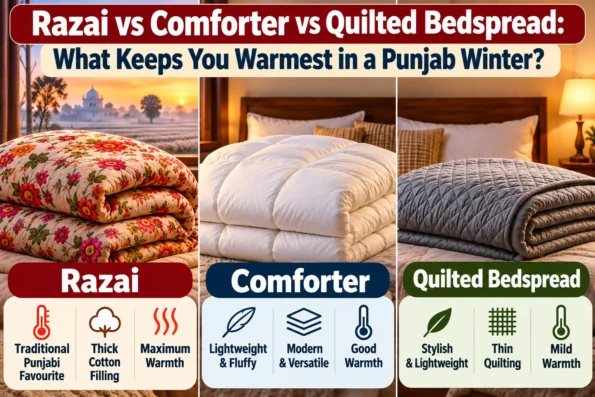
A cotton razai is the warmest, and a quilted bedspread is not built for peak winter
Warmth comes from trapped air, and a razai traps the most. Its thick layer of cotton wool holds a deep pocket of still air around your body. That is why it has kept Punjabi homes warm for generations.
A comforter works the same way with polyester filling, but its warmth depends on how much filling is inside. A light one suits November. A heavy one comes close to a razai.
A quilted bedspread has only a thin layer stitched flat. It is made to lie over the bed and look neat, keep dust off and add a little warmth. On its own it will not see you through a January night.
Punjab nights get colder than the thermometer suggests
Lahore’s usual January night falls to around 6.6°C. During cold waves it drops to about 3°C in Lahore and 0°C in Islamabad. In heavy fog, Lahore has reached 0°C, with Faisalabad and DG Khan at 1°C. The city’s lowest recorded temperature is −2.2°C, in January 2008.
The numbers only tell half the story. Most Punjabi homes are unheated brick, gas pressure drops just when the evening turns cold, and ground-floor rooms stay damp. January humidity sits around 75 percent, and damp cold feels colder than dry cold at the same temperature. So choose bedding for the coldest week of the year, not the average one.
A razai gives the deepest warmth but asks more of you
A traditional razai is filled with carded cotton and is heavy by design. That weight is part of what makes it feel secure on a cold night, and many older family members will not sleep under anything else.
The trade-off is upkeep. Over a few winters the cotton packs down and clumps, the razai thins and loses warmth, and it needs re-carding (dhunai) to fluff it back up. A filled cotton razai also cannot go in a home washing machine. That is why most families keep it inside a washable cover.
If your family already owns a good razai, the smart buy is a cotton cover for it. Our quilt and razai covers are pure cotton, king size at 90 by 95 inches, and the cover is what you wash every week. Measure your razai flat before ordering, because size names vary a lot between sellers.
A comforter warms by its filling weight, so check that number
A comforter is filled and stitched through, and you use it as it comes, with no cover needed. How warm it feels depends almost entirely on how much filling is inside, measured in grams per square metre (GSM).
As a rough guide, a light filling around 200 GSM suits air-conditioned rooms and spring nights. Sets sold in Pakistan commonly sit around 350 GSM, which is comfortable in November and February. A proper winter quilt sits closer to 500 GSM. The gap between 350 and 500 is the gap between comfortable in November and shivering in January.
Our comforter sets are king size, quilted and polyester filled. They come with a bed sheet (94 by 97 inches) and four pillow covers, and the 8 piece set adds two cushion covers. The fill weight is not printed on each listing, so ask on WhatsApp at 0324 492 4274 before you order if you need it for the coldest weeks. For late December and January, plan to add a blanket on top of a mid-weight comforter.
A quilted bedspread dresses the bed and adds only a little warmth
A bedspread lies over the sheet and pillows to give the bed a finished look. Ours are embossed quilted bedspread sets, 3 pieces, with the pattern pressed into the cloth and a light quilted layer.
It earns its place in three ways. It keeps dust off the bed through the day, which matters in Punjab’s dry months. It is enough on its own for October nights and early March. And on the coldest nights it goes on top of a comforter or razai as an extra layer that holds the warmth in.
What it will not do is replace a winter cover. If someone tells you a bedspread is enough for January in Lahore, they are selling, not advising.
Which one to use each month in Punjab
Punjab’s winter runs in stages, and one cover rarely suits all of them. Here is a practical calendar for Lahore, Faisalabad, Gujranwala and Multan.
- October to mid-November: a bedspread or a light blanket over your sheet is enough most nights.
- Late November to mid-December: switch to a mid-weight comforter.
- Late December to the end of January: use a razai, or a comforter with a blanket on top. Add the bedspread over everything on foggy nights.
- February: a comforter on its own is usually enough again.
- March: back to a bedspread or light blanket.
Rawalpindi, Islamabad and the hill areas stay colder for longer, so move each stage a few weeks earlier at the start of winter and later at the end. South Punjab days are milder, but its foggy nights still call for the full January setup.
Which one suits your household
Different people in the same house often need different covers.
For older family members who are used to a razai, keep the razai and give it a fresh cotton cover. Changing what they sleep under rarely goes well. If the weight bothers them, a winter comforter with a blanket is warm without pressing down.
Children kick covers off and spill things, so a washable comforter is easier than a razai. For couples on a king bed, the cover needs to hang 10 to 12 inches over each side, or it slides towards whoever pulls hardest. Guest rooms do well with a comforter set, which is quick to put out and easy to store.
Damp ground-floor rooms are hardest on cotton razais. Air the razai in the sun on dry days, or it will start to smell musty by February.
Layering beats one heavy cover on the coldest nights
Two or three layers keep you warmer than one thick cover, because each layer traps its own pocket of air. You can also add or remove one as the night changes.
Build the bed from the bottom up: a cotton or velvet bed sheet on the mattress, then a blanket, then the comforter or razai, and the bedspread on top. A warm bed sheet makes a bigger difference than most people expect, because the mattress pulls heat from your back all night.
One safety point every winter: never leave a gas heater running in a closed bedroom while you sleep. Warm the room, switch it off, and let the bedding do the rest.
Care decides how warm your bedding stays next year
Bedding that is stored damp or washed wrongly loses its warmth.
Keep a razai in a cover, air it in the sun regularly through winter, and have the cotton re-carded when it feels thin or lumpy. Store it dry in a cotton bag over summer, not sealed in plastic.
Wash a comforter only if your machine can take a king size filled quilt, on a cold, gentle cycle. Otherwise send it to a dry cleaner. Dry it fully before folding, and shake it out so the filling spreads evenly instead of clumping at one end.
A bedspread washes much like a bed sheet. Follow the care note on its listing, and keep a hot iron off the embossed pattern.
What to check before you order online
Buying winter bedding online saves a trip to the market, but a few checks prevent a disappointing delivery.
- Filling: look for the fill type and weight, or ask. A listing that says only “warm” tells you nothing.
- Stitching: look closely at the corners in the photos. Weak corner stitching is the most common complaint in bedding reviews.
- Size: measure your razai or bed first. Our king razai cover is 90 by 95 inches, while another seller’s “king” measures 104 by 94. The same word can mean 14 inches of difference.
- Timing: our comforter sets are stitched to order with 50 percent paid in advance, so order before the first cold week, not during it. Ready items usually arrive in 2 to 6 days.
- Returns: we offer cash on delivery and a 7-day replacement if anything arrives faulty or does not fit.
Frequently asked questions
Which is warmer, a razai or a comforter?
A thick cotton razai is usually warmer, because its deep cotton layer traps more air. A comforter with around 500 GSM filling comes close, and it is lighter and easier to wash. A comforter around 350 GSM is comfortable in November and February but needs a blanket on top in January.
Is a quilted bedspread enough for winter?
Not for December and January in Punjab. A quilted bedspread has only a thin stitched layer. It is enough for October nights and early March, and it makes a useful top layer over a comforter or razai on the coldest nights.
What GSM comforter do I need for a Lahore winter?
Around 350 GSM covers late autumn and February. For late December and January, choose closer to 500 GSM, or use a mid-weight comforter with a blanket on top. Ask the seller for the fill weight if the listing does not show it.
How often should a cotton razai be re-carded?
When it feels thin, lumpy or less warm than it used to, which for many families is every few winters. Re-carding (dhunai) fluffs the packed cotton back up so it traps air again.
Can I wash a razai at home?
A filled cotton razai should not go in a home washing machine. Keep it in a washable cotton cover, air it in the sun, and send it for cleaning when needed. Wash the cover at home every week or two.
What is the difference between a razai cover and a quilt cover?
They are the same thing: an empty cloth case that a filled razai or quilt slips inside. Sellers in Pakistan use the names interchangeably. What differs is what comes in the set, so check whether a bed sheet and pillow covers are included.
Razai or comforter for elderly parents?
If they are used to a razai, keep it and give it a fresh cotton cover, since familiar bedding usually sleeps better. If the weight bothers them, a winter comforter with a blanket is warm without pressing down.
Do your comforter sets come filled?
Yes. Our comforter sets come with a quilted, polyester-filled king size comforter, a bed sheet and pillow covers. Our quilt covers are covers only, for a razai you already own.