


A bedsheet can be washed perfectly and still smell stale when you take it out again. In Pakistan, the problem is rarely the wash. It is what happens afterwards: a sheet put away slightly damp, a shelf with no airflow, a plastic bag sealed in monsoon humidity, or a heavy velvet set crushed under a pile for six months.
This guide explains how to store bedsheets so they come out fresh, keep their colour and shape, and fit in a real Pakistani almari — without buying expensive storage furniture.
Why Storage Goes Wrong in Pakistan
Three things work against stored bedding here: humidity, heat, and dust.
During the monsoon, air stays damp for days. Cotton absorbs moisture easily, and a closed almari can trap it. A sheet that felt dry to the touch may still hold enough dampness in its folds to develop a musty smell. Karachi’s humid air, Lahore’s monsoon weeks, and the damp cold of a northern winter all create the same risk in different ways: moisture with nowhere to go.
Heat and sunlight cause a different kind of damage. Direct sun fades printed colours over time, and a hot loft or mumty can make elastic weaken and colours look dull. Dust settles into open shelves and into the top sheet of a stack, so the set you use least often is often the dirtiest when you need it.
The fix is not complicated. Store only completely dry sheets, give them air, keep them off the floor, and check them during the monsoon. Most storage problems come from skipping one of those four steps.
Before You Store: Wash, Dry Completely, Then Fold
Never store a sheet that has been used, even lightly. Body oils, sweat, dust, and a small stain left on the fabric can yellow over time and attract pests. Wash the sheet with a mild detergent, following the care label, before it goes away for the season.
Drying matters more than washing. Even a tiny bit of moisture can lead to mildew, a musty smell, and fabric damage, so make sure sheets are bone dry before folding. In Pakistan, line drying in shade with good airflow is usually the safest option for printed and embroidered sheets, because prolonged direct sun can fade colours. White, plain cotton can take a short period of sun, but printed, dark, and embroidered sets should dry in shade.
Do a simple check before folding: press the thickest part — the seams, hems, and the centre of a folded fitted sheet — between your hands. If it feels cool or slightly damp, give it more time. A sheet that is dry on the surface and damp inside the fold is the most common cause of a musty smell later.
Ironing is optional. A light iron smooths wrinkles and makes folding easier, but it is not needed for storage. If you iron velvet or an embossed set, work from the reverse side and never press the patterned face directly, because heat and pressure can flatten the pile. For embroidered sheets, iron from the reverse so the iron never sits on the stitching.
Check for small repairs before storing. A loose hem or a small tear is easier to fix now than after months in storage, when it may have grown.
The Best Place to Store Bedsheets in a Pakistani Home
The ideal place is cool, dry, and dark, with some airflow — a linen shelf in a bedroom almari, a dry storage box under the bed, or a clean, dry loft shelf away from a leaking roof. A linen closet or drawer away from direct sunlight and humidity is ideal, because humidity can encourage mildew growth.
Avoid these places:
- A bathroom cupboard: Steam from showers keeps the air damp, and bedding stored there is one of the fastest ways to get mould and a musty smell.
- Directly on the floor: Floors collect dust and damp, especially during the monsoon and after floor washing. Keep storage at least a few inches off the floor.
- A hot, sealed loft in summer: Extreme heat can weaken elastic and fade colours, and a leaking roof can ruin a whole stack in one rain.
- Next to strong-smelling items: Shoes, cleaning products, and mothballs can leave a smell on fabric that is hard to wash out. Keep bedding separate.
If your only storage is a shared almari, give bedding its own shelf or section, away from clothes that are worn daily and away from the bottom shelf where floor damp reaches first. Leave a small gap at the back of the shelf so air can move behind the stack.
Breathable Storage vs Plastic: What to Use
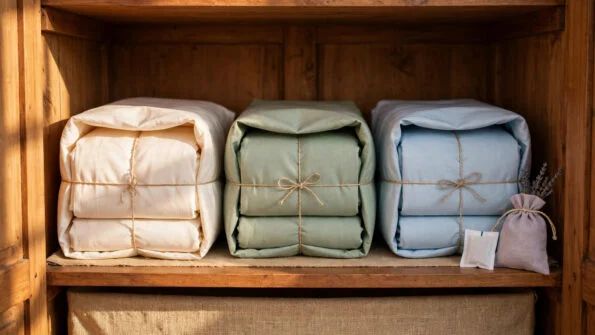
For most homes, the best storage is simple: a clean cotton bag, a cotton pillowcase, or an open shelf with a light cotton cover. Breathable storage lets air circulate, which is what keeps cotton fresh.
Plastic can trap moisture and lead to mould, so breathable cotton or linen bags are better than sealed plastic bags for long-term storage. That rule matters most in the monsoon. A sheet sealed in plastic while even slightly damp has nowhere for the moisture to go.
That does not mean plastic is always wrong. A clean, dry plastic storage box with a lid can protect against dust and insects, especially under a bed — but only if the sheets inside are completely dry, the box is clean and dry, and you open it to air the contents every few weeks during humid months. Do not use thin plastic shopping bags or sealed polythene for seasonal storage.
| Storage option | Best for | Watch out for |
|---|---|---|
| Open almari shelf, covered with a cotton cloth | Sets used every few weeks | Dust on the top set; keep the shelf clean |
| Breathable cotton bag or pillowcase bundle | One complete set, small almari | Must be fully dry before packing |
| Clean plastic box with lid, under the bed | Dust and insect protection, small homes | Open and air during the monsoon; never pack damp sheets |
| Vacuum bag | Bulky winter velvet or comforter, short-term space saving | Can crush velvet pile and crease cotton; check it has not trapped moisture |
| Suitcase or storage trunk | Guest sets used rarely | Keep off the floor, add a moisture absorber, and air every 2–3 months |
For velvet and other pile fabrics, avoid heavy compression. Vacuum bags save space, but long-term compression can flatten the raised pile that gives velvet its look. Fold velvet loosely, store it flat, and do not stack heavy items on top of it.
How to Fold and Organise Sets So You Can Find Them
The simplest system in a small almari is to keep each set together. Fold the fitted sheet, flat sheet, and pillow covers, then place the whole set inside one of its own pillowcases. That keeps the set together, saves space, and means you never hunt for a missing pillow cover. Folding sheets neatly and placing the folded fitted sheet and pillowcases inside the folded flat sheet, or bundling the entire set inside one pillowcase, makes a compact, self-contained package.
A few organisation habits help more than fancy boxes:
- Group by bed, not by colour: Keep the double-bed sets together, the single-bed sets together, and the kids’ sets together. Colour grouping looks neat but makes bed-changing slower.
- Group by season: Put summer cotton sets where you can reach them in summer, and winter velvet and comforter sets at the back or on a higher shelf. Swap them when the season changes, and use the swap as your check-and-air moment.
- Put the oldest set on top: Use sets in rotation. A set left at the bottom for a year will fade, crease, and smell worse than a set used regularly.
- Label rarely used sets: A small paper label — “Guest double, cotton satin” — saves opening every bundle to find the right one. Do not stick tape directly on fabric.
- Do not overfill a shelf: Fabrics need room to breathe to stay fresh, and jamming too many items into a small space restricts airflow and increases permanent creasing. If a shelf is packed tight, move one set to another shelf or box.
For a fitted sheet, fold it into a neat rectangle: tuck the elastic corners into each other, smooth it flat, then fold it to the same size as the flat sheet. It takes one extra minute, but it stops the fitted sheet from turning into a bulky ball that eats shelf space and creases badly.
Monsoon Damp: Prevention and the Mid-Season Check
Monsoon damp is the biggest storage risk in Pakistan, and it is also the easiest to prevent if you check once during the season.
Before the monsoon, make sure off-season sets are completely dry and stored off the floor, away from walls that get damp in rain. If a wall in your almari room shows damp patches, do not store bedding against that wall.
During the monsoon, air stored bedding every 2–3 months — in practice, once in the middle of the monsoon is enough for most homes. Take each set out, shake it, let it air in a dry room with a fan or open window for an hour, and check for a damp feel or a musty smell. If a set feels damp, dry it fully before putting it back. Airing out stored bedding every few months helps maintain freshness while reducing the risk of stale odours.
Moisture absorbers help in a closed almari, but they are a support, not a fix for damp sheets. Silica gel packets, a small container of uncooked rice in a breathable cloth bag, or a charcoal moisture absorber can reduce dampness in a small, closed space. Replace or dry them out as directed, and keep them away from direct contact with fabric. If your almari smells damp, the room needs ventilation first — open a window or run a fan for a while each day, and do not keep the almari door shut tight for weeks in humid weather.
Warning signs to act on quickly:
- A musty or sour smell when you open the almari
- Dark spots, or a grey-green patch on a fold
- A sheet that feels cool and damp even though it was dry when stored
- Small insects or silverfish near the shelf
If you see mould spots, do not shake the sheet indoors near other bedding. Wash it separately with a mild detergent, dry it fully in shade with airflow, and clean and dry the shelf before putting anything back. If the smell or spots do not go after washing and full drying, do not store that set with clean bedding.
Smell: Why Stored Sheets Smell, and How to Fix It
Musty smell in sheets is primarily caused by moisture combining with body oils, sweat, and dead skin cells, which create an ideal environment for bacteria and mould to thrive. Poor air circulation, humidity, and storing sheets before they are fully dry make it worse. That is why a sheet can smell stale even if it was washed before storage: the smell often starts with dampness trapped in the fold.
To remove a musty smell from a stored set:
- Air it first: Shake it out and hang it in shade with airflow for a few hours. Often, a light stale smell clears with airing alone.
- Rewash it: Wash with a mild detergent, following the care label. For plain cotton, a cup of white vinegar in the rinse cycle is a common home remedy for neutralising odours; for printed, embroidered, or velvet sets, stick to a mild detergent and cold water, and do not use bleach.
- Dry it completely: This step matters most. A rewashed sheet put away damp will smell worse than before.
- Check the shelf: Wipe the shelf dry, let it air, and only then put the set back. A damp shelf will undo a clean wash.
To prevent smell in the first place, add a natural freshener between stacks, not on the fabric itself. Sachets of dried lavender or cedar blocks between the stacks can give a subtle fragrance and help deter moths. A wrapped bar of mild soap in the almari can also keep bedding smelling fresh. Keep scented items in a cloth bag or wrapper, so oils and colour do not transfer to the sheet.
Avoid mothballs directly on bedding. They leave a strong smell that is hard to remove, and they should be kept away from children and away from direct contact with fabric. Natural sachets and clean, dry storage are safer for bedding that touches skin every night.
Storing Different Fabrics: Cotton, Velvet, Embroidered, and Baby Bedding
Not every fabric stores the same way. Use the table as a quick check before you pack a set away.
Cotton and cotton satin: These are the easiest to store, but cotton absorbs moisture easily, so complete drying and airflow matter most. Fold neatly, store in a breathable bag or on a shelf, and rotate regularly. Cotton satin shows creases less than plain cotton, but heavy stacking can still leave fold marks — do not put a heavy winter set on top of satin sets.
Jeans weave: A heavier, tighter weave that holds colour well and takes hard use. It stores well in a stack, but it is heavier than cotton, so keep jeans sets at the bottom of a stack rather than on top of lighter sheets.
Velvet and embossed velvet: Store flat and loosely folded, with nothing heavy on top. The raised pile can crush under weight or in a vacuum bag. Keep velvet away from direct sun and heat, wash cold and dry flat in shade when it needs washing, and never iron the patterned face. If the pile looks lightly crushed after storage, mist it lightly with water and brush gently in the direction of the pile once it is dry.
Embroidered sets: Fold with the embroidery facing in, so the stitching is protected and does not catch on other items. Store embroidered sets where they will not be pulled out roughly — a caught thread can snag. Wash cold, inside out, and dry in shade so thread colour holds.
Bridal sets: Store bridal and show sets separately from daily-use sets, in a clean, dry place where they will not be crushed. Keep them in a breathable cover, check them once during the monsoon, and do not store heavy items on top of embroidery or embellishment.
Baby nests and cot bedding: Store baby bedding separately from adult bedding, clean and fully dry, in a breathable bag or clean box. Check it before use, even if it was stored clean — baby bedding should always be aired and, if it smells stale, rewashed before a baby sleeps on it.
Almari Space: Making a Small Almari Work
Most Pakistani homes do not have a separate linen cupboard. The almari has to hold clothes, bedding, and guest sets together. These small changes make the biggest difference:
- Use the full height: Put rarely used guest and winter sets on the top shelf, daily sets at arm height, and nothing bedding-related on the floor-level shelf.
- Use vertical space, not deeper stacks: Two shorter stacks are easier to use and air better than one tall stack that you have to pull apart to reach the bottom set.
- Keep one shelf for bedding only, if you can: Even a half-shelf kept only for bedding stops clothes, shoes, and bags from crushing and scenting the sheets.
- Use a thin cotton sheet as a shelf cover: It protects the bottom set from dust and from a rough wooden shelf, and it can be washed easily.
- Keep a small gap for air: Do not push stacks hard against the back wall, especially an outside wall in the monsoon. A finger-width gap helps air move.
- Rotate at every bed change: When you change the bed, put the fresh set on and the washed set back on top of its group, so no set sits untouched for a year.
If you have a storage box under the bed, use it for off-season sets only, not for the set you need next week. Under-bed boxes are hard to air, so open them during the monsoon check even if you do not need the contents.
What Not to Do When Storing Bedsheets
- Do not store a sheet while it is damp, even slightly.
- Do not seal a damp sheet in plastic.
- Do not store dirty or lightly used sheets for the season.
- Do not put heavy winter bedding on top of light cotton or satin sets.
- Do not store bedding in a bathroom cupboard or against a damp wall.
- Do not leave mothballs in direct contact with fabric.
- Do not iron velvet or embossed patterns on the patterned face.
- Do not leave stored bedding unchecked through a whole monsoon.
Most of these mistakes are easy to make once and easy to avoid afterwards. The cost of one damp storage mistake — a set that smells, spots, or fades — is usually higher than the few minutes it takes to dry and check it properly.
Quick Storage Checklist
Use this checklist when you put a set away for the season:
- Washed with mild detergent, stain checked.
- Completely dry, including seams and folds.
- Folded neatly, set kept together in its own pillowcase or cotton bag.
- Stored cool, dry, and dark, off the floor, away from a damp wall.
- Nothing heavy stacked on velvet or embroidery.
- A lavender or cedar sachet nearby, not directly on the fabric.
- Shelf labelled by bed and season.
- Monsoon check marked: air and check once mid-monsoon, and again at the season change.
Frequently Asked Questions
How long can I store bedsheets without using them?
A clean, fully dry set can be stored for several months, but in Pakistan it should be aired and checked every 2–3 months, especially during the monsoon. A set left untouched for a year in a closed almari is likely to smell stale and need rewashing before use.
Should I store bedsheets in plastic bags?
For long-term storage, breathable cotton bags are better than sealed plastic, because plastic can trap moisture. A clean, dry plastic box with a lid is fine for dust protection if the sheets are completely dry and you open it to air the contents during humid months.
Why do my stored bedsheets smell musty even though I washed them?
The most common cause is dampness trapped in the fold, or a closed almari with no airflow during humid weather. Rewash, dry completely, air the shelf, and store the set with breathing room. Check the shelf for dampness before putting the set back.
How do I store velvet bedsheets without flattening the pile?
Fold velvet loosely, store it flat, and do not stack heavy items on top or compress it in a vacuum bag for a long time. Keep it away from direct sun and heat, and brush the pile gently in one direction if it looks lightly crushed after storage.
Can I store bedsheets under the bed?
Yes, for off-season sets, if the box is clean, dry, and off the floor, and the sheets inside are completely dry. Open the box to air the contents during the monsoon, and do not use an under-bed box for the set you need every week.
What is the best way to keep moths away from stored bedding?
Keep bedding clean and dry, store it in a breathable bag or closed box, and use lavender or cedar sachets nearby. Avoid mothballs in direct contact with bedding, and check stored sets during the monsoon for insects or damage.
Do I need to wash a stored bedsheet before using it again?
If it was stored clean and dry, was checked during the monsoon, and smells fresh, a good airing is usually enough. If it smells stale, feels damp, or has been stored for many months, rewash it before use — especially for baby and kids’ bedding.
Keep the Next Set Fresh
Good storage is mostly habit: dry fully, store with air, keep sets together, and check once in the monsoon. Do that, and the sheet you stored in winter will still smell fresh when summer comes, and the velvet set you stored in summer will still look rich when winter returns.
If you are choosing new sets to build a rotation — breathable cotton for summer, velvet or a comforter set for winter, and a plain set for guests — choose the fabric for your city and season first, and let storage do the rest.