


Quick Answer
The best curtains for a Pakistani home depend on the room. For bedrooms, heavy velvet in a mid to dark shade blocks the most light and heat. For drawing rooms and TV lounges, a double parda — sheer chiffon for the day and velvet for the evening — handles both privacy and light. For bright rooms you want to keep airy, light silk softens daylight without darkening the room. Measure your window first, hang the rod near the ceiling, and choose the fabric for heat and dust, not just colour.
What You Will Learn in This Article
- The main curtain types, and which one suits which room
- Velvet, silk, cotton, polyester, linen and sheer compared for light, heat, privacy and washing
- The best curtains for bedrooms, drawing rooms, TV lounges, dining rooms and kids’ rooms
- How to measure your window correctly, and the mistakes that waste money
- How to match curtains with your walls, sofa and bedsheets
- How to handle Pakistani heat, dust and monsoon with the right fabric
- Ready-made vs stitched-to-order curtains, and what curtains cost in Pakistan
- How to clean and store curtains so they last
How to Choose the Best Curtains in 60 Seconds
If you do not want to read the whole guide, use this table. Find your room, then pick the fabric in that row.
| Room | Best choice | Why |
|---|---|---|
| Bedroom | Heavy velvet, mid to dark shade | Blocks the most light and afternoon heat; helps you sleep past the early summer sunrise |
| Drawing room / TV lounge | Double parda — chiffon + velvet | Chiffon by day for privacy without darkness; velvet in the evening against sun and glare |
| Dining room | Silk or light velvet | Soft light, formal look, easy to keep bright for guests |
| Kids’ room | Washable cotton or polyester | Gets washed often; light colours hide less dust than dark velvet |
| Kitchen / bathroom | Cotton or polyester, short length | Washable, dries fast, no heavy fabric near steam or splashes |
If your room has a west-facing window with direct afternoon sun, go heavier whatever the room. If the room is already dark, go lighter.
The Main Types of Curtains
Sheer / Chiffon Curtains
Sheer curtains are light, see-through fabrics — chiffon is the common one in Pakistan. They soften daylight, give privacy during the day (people outside see shapes, not details), and keep the room bright. They do not block heat or light at night, and they offer no privacy once the room lights are on after dark. Best used alone in a bright drawing room, or as the day layer of a double parda.
Blackout Curtains
Blackout curtains have a coated backing that stops light almost completely. They are the right answer for a bedroom where a streetlight shines in, a media room, or a baby’s room where daytime sleep matters. Note that a heavy curtain without blackout backing only dims a room — it does not black it out. If you need true darkness, ask for the coated backing, not just a heavy fabric.
Velvet Curtains
Velvet is the heaviest curtain cloth most Pakistani homes buy. It hangs straight, holds its shape, blocks a good deal of light and heat, and deadens sound. It is the best choice for bedrooms and formal drawing rooms. The trade-off: velvet holds dust, so it needs vacuuming every week or two, especially between April and June when Lahore summers are at their dustiest.
Silk Curtains
Silk curtains are lighter, with a soft sheen that shifts through the day. They filter daylight rather than stopping it, which suits a room you want to keep bright — a drawing room or dining room. Silk is usually the most affordable curtain range in a made-to-order store. It suits rooms that catch less direct sun, since strong sun fades lighter fabrics faster.
Plain / Solid Curtains
A plain curtain is a solid-colour panel with no pattern, print or embroidery. It is the right choice when the room already carries pattern — in the bedding, the sofa or the carpet. A solid panel settles the room down. Match it close to your wall colour and the window blends into the room instead of shouting.
Fancy and Embroidered Curtains
Fancy curtains carry the heavier decorative work: embroidery, jacquard, panels and trims. They belong in drawing rooms and formal spaces where the curtain is part of the decoration. Keep the rest of the room simpler when the curtain is fancy, or the room starts to look crowded.
Embossed Curtains
Embossed curtains have a raised pattern pressed into the fabric, giving texture without embroidery. They sit between plain and fancy — more interesting than a solid panel, less busy than embroidery — and work well in drawing rooms and bedrooms where you want depth without a loud print.
Curtain Fabrics Compared
| Fabric | Light blocking | Heat | Privacy | Washing | Best for |
|---|---|---|---|---|---|
| Velvet | Very good | Very good | Very good | Vacuum often; dry clean | Bedroom, drawing room |
| Silk | Low–medium | Low | Medium | Gentle wash / dry clean | Drawing room, dining room |
| Cotton | Medium | Medium | Good | Machine washable | Kids’ room, kitchen, rented flats |
| Polyester / blends | Medium–good | Medium | Good | Easy machine wash | Everyday rooms, busy households |
| Linen / linen-look | Low–medium | Low | Medium | Wrinkles; gentle wash | Airy living rooms |
| Sheer / chiffon | Very low | Very low | Day only | Gentle wash | Day layer, bright rooms |
| Blackout (coated) | Excellent | Good | Excellent | Wipe / gentle wash | Bedroom, media room, baby room |
Two honest notes. First, cotton is cheaper and machine washable, so it suits a kitchen, a children’s room or a rented flat where the curtain gets washed often — but for rooms where weight, drape and light control matter more, velvet and silk do the job better. Second, linen looks beautiful but wrinkles and fades faster in harsh sun; a linen-look polyester blend gives the same feel with a longer life.
What About GSM?
Curtain fabric weight is measured in GSM (grams per square metre). As a rough guide, 150–250 GSM gives a balanced drape for most everyday curtains — lighter for sheers, heavier for thermal or pleated panels. You do not need to memorise the number; just hold the fabric up to a window. If you can see the window frame clearly through it, it will not block much light.
Best Curtains by Room
Bedroom: Heat First, Then Looks
A bedroom curtain has one job above all: darkness and cool air for sleep. Heavy velvet in a mid to dark shade blocks the most light of anything in a standard curtain range, which handles both the early summer sunrise and the afternoon heat on a west-facing window. If you also want the room usable in daylight, choose a four-piece set with chiffon — sheer by day, velvet at night.
The US Department of Energy reports that medium-coloured draperies with a light backing cut heat gain by about a third when closed during the day, and that drawn draperies reduce heat loss from a warm room by up to 10 percent in cold weather — which matters in a Lahore January.
Drawing Room and TV Lounge: The Double Parda
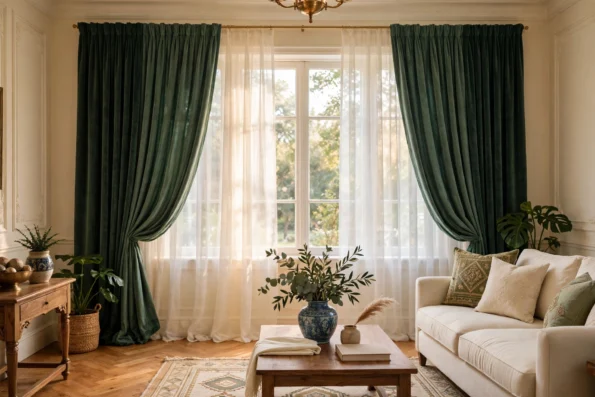
A drawing room has two opposite needs: privacy during the day and darkness in the evening. A single layer cannot do both. The answer is the double parda — a four-piece set with two velvet panels and two chiffon panels. Chiffon stays closed through the day and gives privacy while keeping the room bright. Velvet closes in the evening, or against direct sun, and also cuts the afternoon glare on a TV screen.
For a formal drawing room that guests see and the family uses less, a deep solid colour holds up well — hang the rod near the ceiling and the room reads taller. For a TV lounge or baithak, the weight of the cloth matters more than the shade, because glare is the real problem.
Dining Room
A dining room wants soft light and a formal feel. Silk is the natural pick: it filters daylight, has a gentle sheen, and keeps the room bright for daytime meals. Light velvet works too if the dining room faces west and catches the afternoon sun.
Kids’ Room
Kids’ rooms need curtains that survive washing. Cotton or polyester blends are the practical choice — they go in the machine, dry fast, and do not mind being pulled. Keep colours mid-tone rather than very dark (dark shows dust) or very pale (shows every mark). Short or sill-length curtains are safer than floor-length ones for small children.
Kitchen and Bathroom
Keep it short and washable. Cotton or polyester in sill length, no heavy fabric near steam, splashes or a stove. Heavy velvet has no business in a kitchen — it absorbs cooking smells and is hard to wash.
How to Measure Curtains Correctly
Most curtain mistakes happen before the fabric is even cut. Measure twice, then order.
- Fit the rod first. Fix the rod or track before measuring. Hang it 10–15 cm above the window frame — near the ceiling if you want the room to look taller.
- Measure the width. Measure the rod length, not the window. For a full look, the curtain fabric should be 1.5 to 2 times the rod width when gathered. A flat panel the exact width of the window will look stretched and thin.
- Measure the length. Measure from the rod down to where you want the curtain to end: just above the sill, just below the sill, or to the floor. Floor-length curtains should just kiss the floor — 1–2 cm above it — so they do not drag and collect dust. Puddling (extra fabric pooling on the floor) looks luxurious in a formal room and terrible in a dusty one.
- Measure both sides. Windows and floors are rarely perfectly level in older Pakistani homes. Measure the length on the left, middle and right, and use the shortest.
- Count the panels. A pair means two panels. A four-piece double parda set means two velvet and two chiffon panels. Check what “set” means before you pay — some shops count a pair, others count a single panel.
Common Measuring Mistakes
- Measuring the window instead of the rod — the curtains end up too narrow.
- Hanging the rod right on top of the window frame — the room looks shorter and the curtains block light even when open.
- Ordering floor length for a room with a radiator or furniture under the window — the fabric bunches and fades unevenly.
- Forgetting the gather — a curtain needs extra width to fold; without it, it hangs flat like a bedsheet on a line.
Matching Curtains With Your Room
Colour
- Small room: light colours — cream, off-white, silver, pale grey. They keep the room feeling open. Note that a pure white curtain is hard to find and harder to keep; cream and off-white are the practical palest shades.
- Large room: deep shades — maroon, chocolate brown, deep green, navy. They add warmth and make a big room feel settled.
- Sunny, west-facing window: deep shades hold their colour longest in direct afternoon sun, so black, maroon and chocolate brown are the safer picks.
- Already colourful room: go plain. If the sofa, carpet or bedding has a pattern, a solid curtain is what settles everything down.
Matching With Bedsheets
Curtains and bedsheets share the room, so they should agree with each other, not fight. The simplest rule: if the bedsheet is printed or patterned, keep the curtain plain; if the bedsheet is plain, the curtain can carry the pattern. Match one colour between the two — for example, the curtain’s main shade with the bedsheet’s border or pillow covers — and the room reads as one piece. Velvet curtains pair naturally with velvet-look bedding in the same colour family. If you are choosing both together, our guide to which bedsheet colour suits your bedroom and our bedsheet size guide will help you get the whole room right.
Matching With Walls and Sofa
Match the curtain close to your wall colour when you want the window to disappear, or pick a shade two tones darker than the wall when you want the window to frame the room. For the sofa, either match the curtain to the sofa’s main colour, or match it to the cushions. One match is enough — matching everything to everything looks like a showroom, not a home.
Pakistani Heat, Dust and Monsoon
Curtain advice written for London or Sydney does not survive a Lahore summer, so here is the local version.
- Heat: In Lahore, June is the hottest month and average highs routinely pass 40°C. Heavy curtains closed during the day cut heat gain noticeably — the US Department of Energy figure is around a third with a light-backed drapery. Close the velvet layer before noon on a west-facing window, not after the room is already hot.
- Dust: Velvet holds dust. Vacuum it every week or two from April to June, using the brush attachment, top to bottom. Sheer chiffon shows dust less but needs washing more often because it is thin.
- Monsoon damp: Never store or hang damp curtains. If a curtain gets wet in monsoon rain through an open window, dry it fully before drawing it closed — trapped dampness is what causes the musty smell. The same rule applies to storing spare sets; our guide to storing bedsheets in monsoon damp applies to curtains too.
- Sun fading: Deep colours fade fastest on a south or west window. If the room gets direct afternoon sun, choose a deep shade in a fade-resistant fabric (polyester blends hold colour best), or accept that a silk curtain in that spot will need replacing sooner.
Ready-Made vs Stitched-to-Order
Most curtains in Pakistan are sold one of two ways.
Ready-made curtains come in standard sizes, ready to hang. They are faster and cheaper, and fine for standard windows in rented flats or hostels. The risk is fit — a standard size rarely matches a real window exactly, so they either gape or drag.
Stitched-to-order curtains are cut and stitched after you order, to your window’s measurements. They cost more and take a few days, but they fit properly, hang straight and last longer. This is the better choice for a drawing room or bedroom you live in every day. Our curtains are stitched after you order, so they are made to your window size — you can browse the full range in our curtain designs collection.
What Do Curtains Cost in Pakistan?
Prices depend on fabric, size and whether the set is plain or fancy, so treat these as starting points from our own range:
| Range | What you get | Starting price |
|---|---|---|
| Silk curtains | Light panels, plain, for windows and doors | From Rs 3,900 |
| Velvet curtains | Heavy panels, best light and heat blocking | From around Rs 5,299 |
| Plain curtains (sets of two) | Solid velvet or silk panels, stitched to order | From Rs 5,100 |
| Four-piece velvet + chiffon sets | Double parda — 2 velvet + 2 chiffon + 2 belts | Top of the range |
Sets of two plain panels run from Rs 5,100 to Rs 9,400 depending on the range and your window size. The final price depends on your measurements, because the cloth is cut to your window — a wide drawing-room window costs more than a small bedroom one. All orders are delivered across Pakistan with cash on delivery, and every order carries a seven-day replacement policy.
How to Clean and Care for Curtains
- Vacuum weekly (velvet especially) with a brush attachment. It takes two minutes and doubles the time between washes.
- Wash by fabric, not by habit. Cotton and polyester go in the machine on a gentle cycle. Silk and velvet prefer gentle hand wash or dry cleaning. Sheer chiffon washes gently and dries fast — do not wring it.
- Dry in shade, not direct sun. Sun dries faster but fades colour. Hang curtains to dry in a shaded, airy place.
- Iron on low, from the back. Or hang the curtain while slightly damp — the weight pulls most wrinkles out on its own. For bedsheets the same trick works; see how to wash bedsheets without fading.
- Store spare sets dry and breathing. Fold loosely, keep them off the floor, and do not seal them in plastic through monsoon — trapped dampness causes smell and mildew.
Mistakes to Avoid When Buying Curtains
- Buying for colour alone. Colour is the last decision, not the first. Room, light and heat come first.
- Choosing heavy velvet for a dark room. The room ends up gloomy all day. Light silk would have done the job.
- Choosing sheer for a bedroom. It looks lovely at noon and useless at 6 a.m. when the sun comes up.
- Skipping the measuring. A curtain that is 10 cm short looks wrong every single day. Measure the rod, not the window.
- Forgetting the second layer. One layer cannot do day privacy and night darkness. If the room needs both, budget for the double parda.
- Matching everything. Curtain, sofa, carpet, bedsheet and cushions all in the same print is a showroom, not a home. One pattern, the rest plain.
Frequently Asked Questions
What are the best curtains for a bedroom in Pakistan?
Heavy velvet in a mid to dark shade. It blocks the most light of anything in a standard range, which handles both the early summer sunrise and the afternoon heat on a west-facing window. Choose a four-piece set with chiffon if you also want the room usable in daylight.
Which curtains are best for a drawing room?
A double parda — chiffon for the day and velvet for the evening. Chiffon gives privacy while keeping the room bright; velvet closes against direct sun and TV glare. For a formal drawing room, deep solid colours in velvet or silk look best.
Are blackout curtains worth it?
Yes, if you need true darkness — a streetlight outside the bedroom, a media room, or a baby sleeping in the day. A heavy curtain without blackout backing only dims the room, so if darkness is the point, buy the coated blackout panel, not just a heavier fabric.
What is the best curtain fabric for hot weather?
For heat, velvet blocks the most — closed velvet during the day cuts heat gain noticeably. For a room you want to keep bright and airy, silk filters the light without heating the room up. Cotton and polyester are the practical middle ground: washable, durable and cool enough for everyday rooms.
How do I choose curtain colour?
Match the curtain to the room, not to a trend. Light colours for small or dark rooms; deep shades for large rooms and west-facing windows; plain curtains when the bedding or sofa already has a pattern. Cream, off-white and silver are the safest pale shades.
Should curtains touch the floor?
Floor-length curtains should just kiss the floor — 1–2 cm above it. Longer fabric pooling on the floor (puddling) looks formal but collects dust, which is a real problem in Pakistani summers. In a kids’ room or kitchen, sill length is better.
How often should I wash curtains?
Vacuum weekly, wash every 3–6 months depending on dust and use. Sheer curtains need washing more often because they are thin and show dust; velvet needs vacuuming more often but washing less often. Always dry fully before hanging.
Do you deliver curtains across Pakistan?
Yes. Our curtains are stitched to your window size after you order, delivered across Pakistan with cash on delivery, and covered by a seven-day replacement policy. You can see the full range — velvet, silk, plain, fancy and embossed — in our curtain designs collection.
What is a double parda?
A double parda is a four-piece curtain set: two heavy panels (usually velvet) and two sheer panels (usually chiffon), plus belts. The sheer stays closed during the day for privacy with light; the heavy layer closes at night or against strong sun. It is the most practical arrangement for drawing rooms and TV lounges in Pakistan.
Can I match my curtains with my bedsheets?
Yes, and you should. Keep one of them plain — printed bedsheet, plain curtain, or the other way round — and match one colour between them. Velvet curtains pair naturally with velvet-look bedding in the same colour family; silk curtains suit lighter, brighter bedding. For plain rooms, our plain curtains and fancy curtains are the two ranges to compare first.